As a child, it seemed idiotic to wait nearly two hours for a geyser to go off, no matter how famous it was. There were bugs crawling along the log I was lying on, but I didn’t care. I wasn’t afraid of tree ants; there was comfort in the way they worked and traveled together. I felt something crawl across my arm and I let it – no matter, so long as it wasn’t a fire ant. I’d find out fairly soon if it was or not. The bark of the log pulled my hair as my curls caught in my turn to get comfortable, get the sun out of my eyes. After a few seconds of teetering, I decided I didn’t want any creepy-crawlies easily making their way into my ear, so I returned to my back.
I looked up at the sky through the tree branches and tried to imagine myself lying on the ground in Iowa instead of Wyoming. The sky would look the same. The sun would be streaming through the branches, sifted by the pine needles. There were three pine trees in our backyard back home, and when I could bear to get down upon them, they were somewhat painless – semi-comfortable even, like some dastardly feather pillow. A wrong move would mean a quick stick, maybe some blood if my skin hadn’t thickened in that particular spot. I could watch the sun shine through any of these trees’ branches, and oftentimes my sister would join me. We’d talk about our parents and make-believe, often about our other families, from before we were adopted.
All the blood in my body had rushed to my forehead, and the throbbing had made the trip around Yellowstone National Park painful and annoying. The place was full of contradictions. Out here in the open mountain air, I was experiencing the worst headache of my life. Yes, it was undoubtedly because of the altitude and the fact that I was lying down (I would later find that this worsens altitude sickness), but the annoyance it produced made me think of other things.
Like how if I closed my eyes, here in the great escape, the wilderness of America, there were still hordes of people. The tiny town of Humboldt, Iowa hadn’t even seemed this bustling, with the exception of the Fourth of July or Homecoming. Even in a wildlife sanctuary, people crowded themselves in, just to take in “the sights” and get a keychain they’d toss on their desk when they got home, to find a year or two later and wonder, “do I keep this?” After another year, they’ll find it at the bottom of their junk drawer, and throw it out with the spring cleaning. Who needs a memento when you have a hundred burst photos of Old Faithful spouting off. It had reached the sky, and a consensus of glory-filled “oos” and “ahhs” as it spouted within its appropriate time frame. From my tree log view, it disappeared into the branches above.
I got a moose keychain instead of a geyser one at the last gas-stop we found near the lodge we’d stayed in the night before. The lodge was lacking, with a heavy-handed rustic décor, forest-set wallpaper, and the kind of flickering lighting reminiscent of a horror movie. My sister’s biggest concern was that there was no television, but we were happy to have a cheap place to stay, and a pet-friendly one so our dog Chloe could come along and bark at whatever larger animal she decided to harass along the way.
It bothered me how there was more wildlife outside of the park than inside it. From our van, we’d seen herds of bison roaming around, as well as elk or moose. I didn’t know which, and I didn’t care, but I envied them. They were free, and could go where they wished. I liked the moose more than the others. The bison traveled in large herds, grouping together to fend off danger and protect their young. The moose were more independent, fending for themselves against the most dangerous creatures in the wild. Their demeanor was gruff, imposing. You seldom hear of people eating moose, but we’d had “buffalo burgers” before. There were pests everywhere — that hadn’t changed from the minute we’d arrived. There were ants crawling along the windowsill by my bed, and it seemed like they were meant to be there, more than me.
The fact that we had come here at all bothered me most. The park was a stop-along-the-way. It was a distraction and an attempt to normalize the family trip we were taking to Thermopolis, or rather, just outside. Down a long dirt path, past an arch of trees would stand two houses on either side of a great clearing facing a river. One house being the guest house where we’d be staying, and the other belonged to Roy. Or as my birth certificate referred to him, my birth-father. Or, according to my adoptive parents, my uncle. He and his wife Marge had inherited their house from my grandparents, and had put up the guest house themselves. In the pictures they had sent, it looked like a very modern house – solar panels, a spiral staircase to an upper level, floor-to-ceiling windows to watch the here-and-gone Wyoming rain, and one of those banana islands to eat breakfast on. It looked nicer than our house in Iowa, but it didn’t look like a home.
Tomorrow we’d be on our way there, to see Roy and Marge. My birth-father and his wife. My uncle and aunt.
I could barely remember when I was very small and Roy had come for my birthday. We stayed at a hotel to celebrate, to swim at the pool and cause a ruckus. Roy had come to play cards over cake and ice cream. He looked like me. My parents had made my history clear, as appropriately as they could at that age. I hadn’t known what to call him, so I called him “Dad”. It felt odd, like saying “I love you” to a friend you haven’t known for that long. Just testing it out. It felt disrespectful to call him Roy, and I was afraid “Uncle” would feel dishonest. After he left, my dad was in a rotten mood, and my mind flickered back to the stoic expressions I hadn’t paid much attention to during the party. I knew he was acutely aware of the confusion, but I didn’t know what to say. I shouldn’t have had to say. In a long-standing trend, we all went to bed without saying “I love you.” Now, to address Roy I begin with “hey…”
Marge had made it easy. She was from Salt Lake City and had Lyme Disease. She knew her way around a kitchen, and knew how to make a Native American teepee. She layered her neck with strings of polished stones. The tiger’s eye and turquoise were my favorite. They clattered together around her tanned neck. When she spoke, it was easy to pay attention to her; it was almost a distraction from where I was and who I was with. I could ask her questions about her heritage and why she said “Oh, gol” instead of “golly” when she found something surprising or disheartening. When she met me, she said, “You can call me Marge.”
Soon we’d be down that dirt road, beyond those trees, and near that river. I’d be in a house that wasn’t mine, with family, greeting more family.
Family. Another confusing name that gets caught sometimes.
The next morning, we packed up the car and headed toward my family. The dirt road and trees were just as they looked in the photos, just as entrapping. As we drove down the road, the trees seemed to overtake us, one passing after the other, each low-hanging branch getting closer, then disappearing over the windshield to reveal the next mossy row of eating teeth. The day seemed to be flashing at us, teasing us with the sunlight between the branches. It was hurting my eyes. I turned around to look back up the road we were quickly traveling, but I couldn’t see where we’d come from. The road was covered in a cloud of reddish-brown dust. The storm we were kicking up swallowed the view of the branches, the sun, and the way home. Then the car filled with light, and I was pulled and pointed to look through the windshield. On the other side was a clearing, two houses, and two small figures waving greetings.
We’d arrived, and they stood on the porch waiting for us. They’d been expecting us. They came down the stairs, their smiles and arms made wide. My parents gave them hugs, and I was expected to, too. The hug was quick and awkward; a pat for a dog that could bite you. They were being friendly, opening their home to us. They’d invited us out here to share the holiday with us, and I should be happy to see them and to be here, I should be grateful. They helped us unpack our car and get settled in the guest house, Roy pat-patting me on the back every so often, tensing my shoulders and raising hackles.
The guest house was magnificent in person. It was in an odd shape, like someone had made the front of a house, and then chopped the backside off to push it up flush with a wall. Inside, there was a lofted ceiling with a skylight, allowing us to see the stars at night, and rise with the sun whether we’d like to or not. Of the four walls that made up the house, one was windowless. The wall that was only wall contained the majority of the house. Toward the back on one side, there was the bathroom, and on the other was the master bedroom where my parents would settle. Toward the front of the house, brightened by a glass door and two wide windows, there was a modernized kitchen and dining area on one end and a lounging area on the other. Throwing my things to the ground, I chose to lounge first. There was a monstrous brown leather loveseat and armchair. They both squeaked loudly whenever I attempted to sit on them, so before long I got embarrassed and gave up trying to get comfortable.
There was no television, much like Yellowstone. It wasn’t good for the soul, Marge had said, or something like that. “Something that doesn’t live shouldn’t make so much noise.” She suggested I go outside to explore the woods nearby, or go canoeing in the river. I explained that I was nine years old and my mother wouldn’t allow me to do either activities without someone, especially with no experience. Marge shrugged, “I’m sure Roy would take you.”
To occupy my time indoors for the days ahead, I found an old transistor radio. I’d set it up on the coffee table, which was essentially a log, and fiddle with its antenna. It required a two-minute-minimum of fiddling before it would settle on one of the less-crackly stations, though they all seemed to only play a static-clung Hank Williams and Johnny Cash. Neither of their music appealed to me personally, but they had a certain rustic charm that appealed to the country aesthetic I was drowning in, so I turned it up as loud as it would go until I was sent to my room.
Toward the middle of the first floor, there was a sea-green spiral staircase that led to the second floor where my sister and I would sleep at night. There was no wall or door containing this floor – it was more of a balcony, and if Amaris and I weren’t pacing on the lower floor we were above, avoiding our family and looking out the windows through the posts of the railing. These great, wide windows ran almost floor-to-ceiling, let the sun in, and allowed us to watch the clouds pass by in the distance. My sister and I sat in our bright spot on the floor, whispering, swatting each other and sunning ourselves like big, lazy cats. Perhaps it made more sense to go outside, but the unknown frightened us. We had that first day to settle in.
We’d never been to Wyoming, but we knew what we’d heard. Wyoming was mountains, rock slides, coyotes and porcupines. Even more frightening, it was fire ants, wolves, and a variety of snakes and spiders whose venom could take the skin right off your bones. And then, though less frightening, there was the rain. Wyoming was a dry state, sure. It only received an average of ten inches of rainfall in the summer, and at Roy’s house, we were at a “lower” altitude, by a river, where there could be eight inches of rain or less per month.
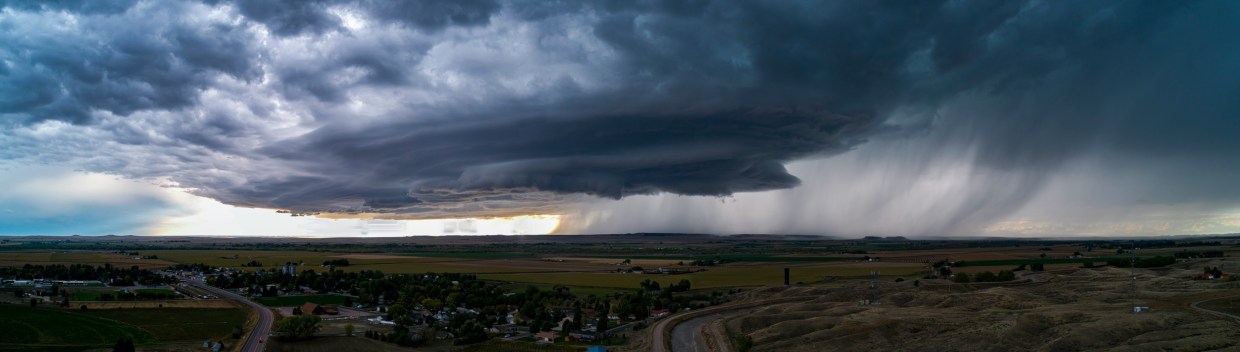
This year must have been wetter than average, because it seemed that anytime we were situated outside for more than an hour or two at a time, the sky would pour down all ten inches the weatherman had promised for the month. It would pour for a minute or two, and then fade through a sun-streaming drizzle until the heat made it mist. It felt silly to run inside to avoid getting soaked at times, only to find the air as hot and dry as before, a short while later. “That’s the Lord crying over your sins,” my mother would say. Afterward, you’d have to avoid the pools of red mud that formed here and there, attracting bugs and threatening to ruin your shoes. In the coming days I would stay outside, to feel the strength of the water beating against me, the heaviness of wet clothes, my sins, and God’s tears. The sky would clear to reveal the sun’s rays and heat the air again, making my skin feel tight and refreshed, ready to hold in my sin.
Greater than the unknown, was the known. Two hundred feet or so from the guest house, across the driveway, was Roy’s house. It was the morning of the Fourth of July, and Marge hosted our breakfast there. We found our plates filled with fried eggs and bacon, biscuits and gravy, and a sizzling platter of sausages, tomatoes, and peppers. But I’d lost my appetite watching it be prepared. I was tasked with helping Marge crack eggs, and as I released the mass into the bowl, I found a beak attached. The baby bird’s feathers were slicked down with its fluid like the hair on a newborn’s head, and its eyes were like a shark’s — black and lifeless. Marge scooped it up in another halved shell with an “oh, gol” and tossed it into her compost. She explained that some eggs happen to be fertilized, especially when you get them from the farmer’s market, like she had. It was uncommon, but it could happen like any other accident. It shouldn’t ruin the other eggs in the bowl, she said. I watched the other deposits closely, with a weight in my stomach.
We prayed before dinner. Thank you for this bountiful feast, for America, and for our family. “You’re a growing boy, get going!” Roy told me at the table as I stared at my plate. In response, I shoveled everything in in fewer mouthfuls than was polite and was grateful, at least not to speak. Roy laughed and patted me on the back.
I was glad to be put to work immediately after breakfast. Back at the guest house, I helped my mother boil and peel the eggs and potatoes for a salad. We were supposed to bring a side dish for the barbecue outside later that day. While we rolled the eggs out onto paper towels to shatter the shells, I watched for boiled beaks and asked her about the yard. Wouldn’t there be bugs? Wouldn’t it get too hot? Wouldn’t an animal smell the food and come to eat it, and us? Wouldn’t it just rain as soon as we sat down to eat? She hushed me and said it didn’t matter — it was a holiday, and I should only be worried about having fun, contributing, and shouldn’t I maybe be talking to Roy more. None of those things were a big deal, besides the animals and Roy, and both were unlikely to happen. We added mayonnaise, mustard, sweet relish, paprika, salt and pepper, and then the salad was ready to chill. I joined Amaris to sit in the sun listening to Hank until I was handed a bowlful to bring out to the table, carefully, carefully.
I stepped out of the house with the bowl cooling my fingers. Following the path that led from the house to the driveway, I kept an eye on the ground and the salad, trying my best not to trip and drop my contribution. I made it about halfway to the driveway when I began to hear a hissing noise. A snake’s hiss is one of those sounds that I hadn’t heard before outside of a recording or human imitation, but one that terrified me regardless. I stopped moving, and forced my eyes to dart around the ground, searching. I caught its movement against the side of the house, just a few feet away. It was a dark green, perhaps brown, with a yellow stripe following the curve of its body. I didn’t know which end had the tail or the head, and I didn’t wait to find out. I clutched the bowl’s rim tight between my fingers, and ran across the driveway, and tripped up the porch to spill half the salad and my story onto Marge.
“Oh, it was just a garden snake! Did you play with it?” she asked, completely serious, wiping potato and egg from her skirt. I said no, in disbelief anyone would do such a thing. Snakes were wild, like wolves and ants and moose and everything else that lived in the wilderness. They were not to be played with. Roy sat down the porch in his chair smoking, and didn’t comment upon my announcement. I ran back to the house to receive another bowl of salad and a spanking. I didn’t repeat my story to anyone but my sister, who shared in my disgust. The rest of the family arrived, and we began to set up our standard burger and brat barbecue outside.
Before long, I began to feel the prickle of rain on my arms, and I ran onto the porch. I watched as my family grabbed what they could before it got drenched by the rain. I thought that I should help, but I felt a satisfaction at their heaviness, their soaked clothes.
We finished the meal inside, in silence. After dinner, while the adults began to play card games, Amaris and I went into a small room off the main hallway of the house. It was basically a walk-in closet, and it was where Marge had stowed an old VCR TV. We plugged it into the wall and watched Rodger & Hammerstein’s Cinderella. It was the one from 1997, and one of the only movies Roy and Marge had. The rest were old western movies. We laid on the floor and watched the feature, enamored by the magic and music and a royal that looked like us. When it was finished, it was time to go home. We emerged from our make-believe to find our parents in hushed conversation with Roy and Marge, our aunt and uncle. My birth father and his wife.
My parents stood and told Amaris it was time for bed. Roy asked why don’t I stick around and help him clean up. I looked at my parents for an answer, a refusal even, but they were already out of the door without a glance behind them. Amaris gave a wide-eyed wave and ran to catch up with them, disappearing into the dusk beyond the doorway, kicking up dust behind her. Roy and I silently cleaned up the dishes we’d left for later. While I scrubbed the dishes and handed them to him to dry, I hummed like I’d heard Marge do when she washed up. I got into a rhythm. It felt purposeful, a way to be important and avoid conversation at the same time. As we finished the dishes, a silence came over the room.
“Can I go home now?” I asked Roy.
“Sure, want me to walk you?” He replied as we headed toward the door. He pulled out a cigarette.
“No, I’m not scared.” I looked at him, and then the ground, the night.
“Except for those snakes, huh?” He laughed. “It’s okay, I’m scared of some stuff, too.” He winked and pat-patted me on the back. “I’ll see ya tomorrow.”
“Yeah, see ya.”
I stumbled down the porch and headed back in the direction of the guest house. I wanted to go home. Back to Iowa, and back to where I knew what was in the grass, and who was in my family. I kept my eyes on the ground for snakes and ants, stomping against their potential presence and wondering what Roy could be afraid of.
As a child, my fears consisted of the outdoors, and adults I hadn’t grown up with. He was my uncle, my birth father, mostly unknown, and practically lived in the outdoors. Maybe fear works in reverse as you get older, and you fear what you know the most, like being home-bound or your own children. He was the adult, and I was his child. Or his brother’s child. He was afraid of me. He had been afraid to raise me, that’s what I’d been told. He could brave the wilderness, the elements, but fatherhood was too wild, too unknown to be done safely, it was a beak in an egg you thought you could stomach. I began to cry as I made my way across the driveway and up the path to my parents, feeling guilty for running away. I wished for a Wyoming Rain to clear the salty tears from my skin, and replace them with the Lord’s. But the sky remained dry, its stars winking at me, saying, “it’s okay to be afraid.”

 Philip Runia