
It must be intentional that movie theaters darken the auditorium more than usual, when a horror film is shown. As the door closed behind auditorium 2, it was near impossible to know where to find a seat or who was watching the process. The tension was palpable in the darkness, and by the time Michael Chavez’ The Curse of La Llorona (2019) began, any chatter that had accompanied the previews was suffocated by the lamented cries of La Llorona.
The film begins with the beautiful La Llorona (Marisol Ramirez), translated as the weeping woman, spinning in a circle with her two sons. It’s 1673 pastoral Mexico, replete with wide shots of tall grasses and an open, clear sky. The scene is awash with sunlight, belying its cruel twist – that La Llorona was a woman who murdered her children, and will murder yours too if they don’t behave. Enter Anna Garcia (Linda Cardellini) and her two children, Chris (Roman Christou) and Sam (Jaynee-Lynne Kinchen). It’s 1973 Los Angeles – sunny and fun. The tracking shot of the Garcia household flies after a running Sam; it’s spinning to keep up with a home struggling to reset after the untimely death of its patriarch, Anna’s husband. Anna works for child-protective services – a fitting occupation for when La Llorona sets her sting upon Anna’s children.

The film follows standard horror structure, at least within the “Conjuring Universe”. A charming, Rockwell family has one problem: the kids messed with something they shouldn’t have, and now everything’s gone to shit. The Garcia family goes through the gambit until they finally decide to stand up to the banshee, with the help of a Mexican shaman and a few significant objects.
The props in the film are faithful to Mexican culture, and spiritual practice, while giving ample explanation of each cultural artifact. Monica Castillo from Roger Ebert felt that, “…the lead character, Anna (Linda Cardellini), does not identify as Latina, only that she’s the widow of a Latino police officer. Her kids, Chris (Roman Christou) and Sam (Jaynee-Lynne Kinchen), don’t speak Spanish and the family doesn’t seem to keep up any cultural ties other than the last name of Garcia.” While the family may not explicitly display its Latinx heritage, it seems baseless to discredit the film, or Latinx people for that matter, as culturally bland if they do not speak Spanish.
ScreenRant’s Chris Agar said, “the relation to The Conjuring is doubly important here because La Llorona, based on Mexican folklore, is not as widely-known in other areas of the world.” While Agar’s judgement of the film’s success based upon its connections to The Conjuring (Wan, 2013) is important, it fails to recognize the advantageous element of surprise that a horror film’s Easter eggs, plot, and details can contain when not given away within the trailer or promotion. The cultural difference is new and exciting to see onscreen. The significance of the relics is not under or overdone.
The Garcia family uses everything from seeds to windchimes to fight La Llorona, and not without purpose. Each item has been blessed, either by its own good nature, or by a priest such as Annabelle’s (Leonetti, 2014) Father Perez (Tony Amendola) or Rafael (Raymond Cruz), a curandero, or shaman. Each object holds a significant purpose: the seeds are a barrier, the windchimes alert the family of the vengeful spirit, the cross invokes the Lord, and candles are utilized to ward off the darkness.
“La Llorona thrives in darkness,” says Rafael. As is the trend with films in the “Conjuring Universe”, most scenes are vignetted with darkness or sparing light, leading viewers to wonder what is lurking in the corners of each frame. The bright opening shot of La Llorona is the last prominent scene until the final scene that is not overcast at best. However, light plays a significant role in this film in the few moments it is featured. Two moments in which light plays an important role are when La Llorona presents her horrible face to the family.
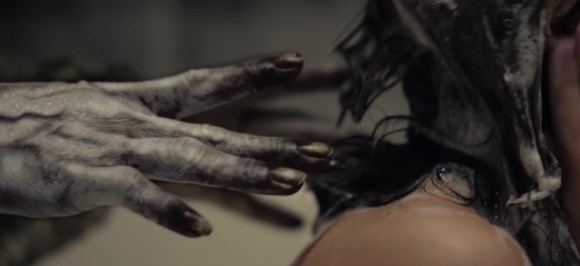
The first is when Sam is taking a bath for the second time in the film. The white-tiled floor and fluorescent light brightens the room. White soap bubbles scatter away from Sam back into the water of the clawfoot tub. “Rinsing,” Sam says for the second time: only this time, it’s not her mother’s hands cradling her head, but La Llorona’s gnarled, white fingers shoving her head underwater as she digs her blackened fingernails into Sam’s scalp. Anna rescues her daughter and tries unsuccessfully to comfort her as the same ghostly fingertips tickle a hello from inside the tub behind Anna’s shoulder. Linda fights the spirit and holds her in the bathroom, telling her children to run. If darkness is where La Llorona thrives, then light is where motherhood flourishes.
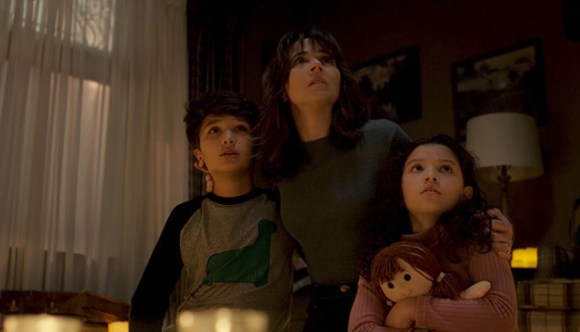
The power of light makes a second statement when the Garcia children are encircled concentrically within their mother’s arms and a crowd of candles to banish the darkness that is La Llorona. She, of course, has powered down the lights to the house. As La Llorona searches quite loudly upstairs, the Garcias sit within their circle hoping for a miracle. As the camera zooms in on the staircase, the flames are swept away by a gust of ghastly wind, beginning at the top of the stairs to the center of the circle. The one remaining lantern illuminates the family just enough to see Anna ripped from her children and thrown into a wall. The light wasn’t enough in this instance, but Anna’s resilience proves to be just as bright, as she continues to fight for her children to the end.
La Llorona may not make you weep, but the film will take your breath away as if she had. Apart from the horror, the exhibition of stalwart motherhood is enough to bring an audience to tears; even the most emotionless of cinephiles.

 Philip Runia