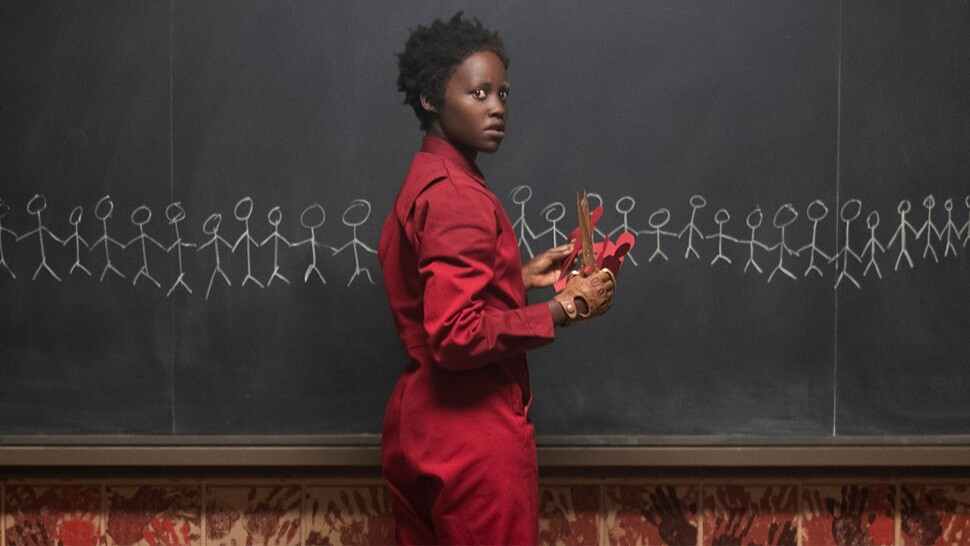
Director Jordan Peele says he hesitates to cast white actors as leads in his films; he’s “seen that movie.” Largely featuring black actors in his films thus far, his films have been labeled as “race” films. In recent years, more directors have tackled politically controversial topics through film as a way to bring more positive awareness to people of color, women, and other underrepresented groups in film.
Breakout directors like Peele have made their name on films like Get Out (Peele, 2017), a film that commented on race relations in America. Barry Jenkins (Moonlight, If Beale Street Could Talk) and Patty Jenkins (Wonder Woman) — what’s up with the Jenkins’? — have similarly been pegged as directors who talk about “the issues” either explicitly or implicitly in their films. However, were these directors to make films that did not focus on the black experience or empowered women, they may find themselves in the same position as Peele: segregated as “women’s” or “black” film.
In Jordan Peele’s second record-breaking feature, Us (Peele, 2019), he takes a different approach to horror, yet again. Still within the political realm, he takes a stab at class rather than race. One may commend his vulnerability and audacity in tackling such “controversial” topics in today’s political climate through film. However, a wide swath of viewers were disappointed when they did not find a political and racial linchpin in Us. Us is a film with black people, the Wilson family, that is not specifically about black people. Groundbreaking.

The draw for Us is not the political undertones, but the real, confusing absurdity of the situation that the family in the film finds themselves in. It is the acting, and the humor that it achieves in its realism while still maintaining its horrific integrity, that saves the day for Us.
Most notably, award-winning actress Lupita Nyong’o commands the screen as her main characters, Adelaide and her double, Red. With a few throaty clicks, guttural moans, or hoarse whispers, Nyong’o brings creepy to a new level. In one of Red’s appearances, she moves across the floor with military precision. She’s a dancer – a ballerina. She flits to a haunting rendition of “Pas de Deux”. Nyong’o keeps both women separate and close in character when appropriate, confusing and teasing the audience through the story. The two characters dance together, tethered.
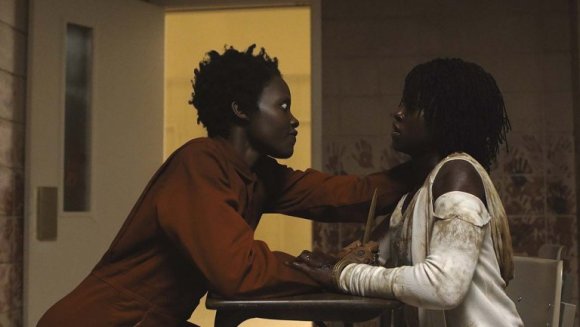
The plot is confusing – a twisted ending may spin viewers onto their heads, but Nyong’o’s performance is a guiding element as she ushers us through this nightmare, by her lights. Her character’s determination, indifference, and desperation at all different points chronologically, gives an ominous, intriguing element to the film which without it, would be lacking.
Originally intended to be an episode of the new The Twilight Zone reboot on CBS All Access, Us was adapted by Peele to be a feature-length film. Peele is the host of The Twilight Zone. Like the show, the film has no clear rules, although Peele attempts to outline a few concerning the red doubles. The plot may fall through if viewers think about it for more than a minute, but they should keep in mind that it’s meant to be hazy – it’s in the twilight zone. Not everything makes sense, and it doesn’t have to. Fans of Us have concluded that for a clearer understanding, re-watching is imperative.
Peele’s films may very well continue to be about political issues, race or not. Perhaps they will deviate further from his current successes, but the merit lies in the skills of Peele and his cast, not the theme that his films may or may not hinge upon.

 Philip Runia